
The short answer
There is no single best Klaviyo agency — there is the right agency for your revenue stage, your category and your tolerance for risk. Enterprise brands above $20M want design-led shops with Shopify Plus depth. Brands under roughly $1M are usually better served by a freelancer or Klaviyo’s own onboarding than by any retainer. The $1M–$10M band, where most DTC brands sit, is where the agency choice actually changes the number — and where you should be asking about guarantees, not case-study multiples.
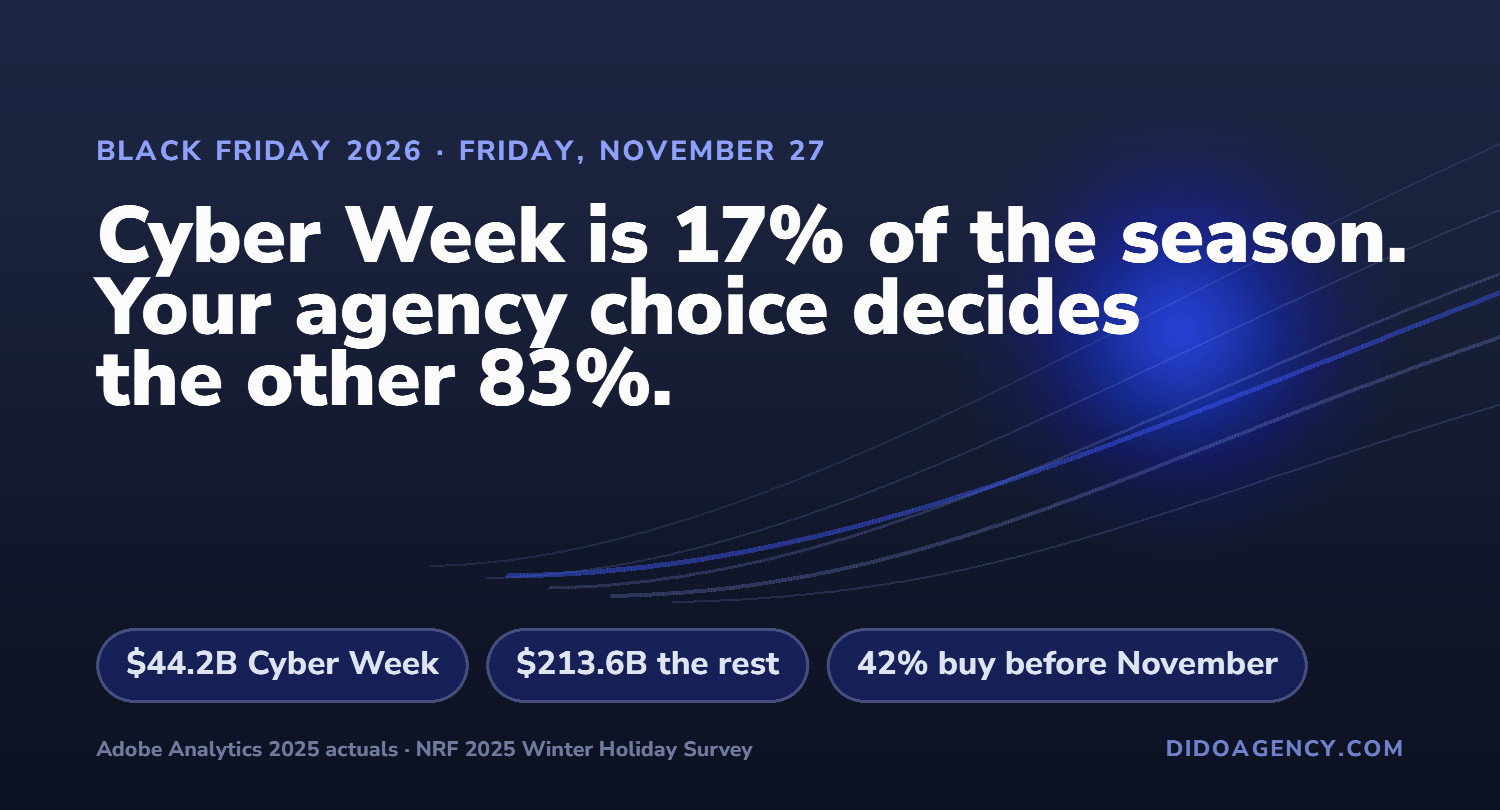
If you are reading this in September or October, the more urgent question is not which agency but whether the one you pick can still build in time. Black Friday 2026 falls on Friday, November 27, with Cyber Monday on November 30. The work that decides those days — list growth, segmentation, sending reputation — has to be finished weeks earlier.
How we built this list
We read every article currently ranking for “best Klaviyo agency” and noticed the same thing you probably did: almost all of them are written by agencies that put themselves at number one, and none of them show you any market data. So this is a different exercise.
For each agency below we used only what they publish about themselves — partner tier, target revenue band, service mix, stated pricing — and we positioned them by who they fit rather than ranking them. We did not score anyone. An agency ranking produced by a competing agency is marketing, and treating it as research is how brands end up on the wrong retainer.
The market figures are Adobe Analytics, the National Retail Federation and Klaviyo’s own BFCM report, all linked at the bottom. Where a number is a forecast rather than an actual, we say so. Where a figure is derived from a reported growth rate rather than published directly, we say that too.
Why does the agency you pick in September decide your Q4?
Because almost none of the revenue is decided during the sale itself.
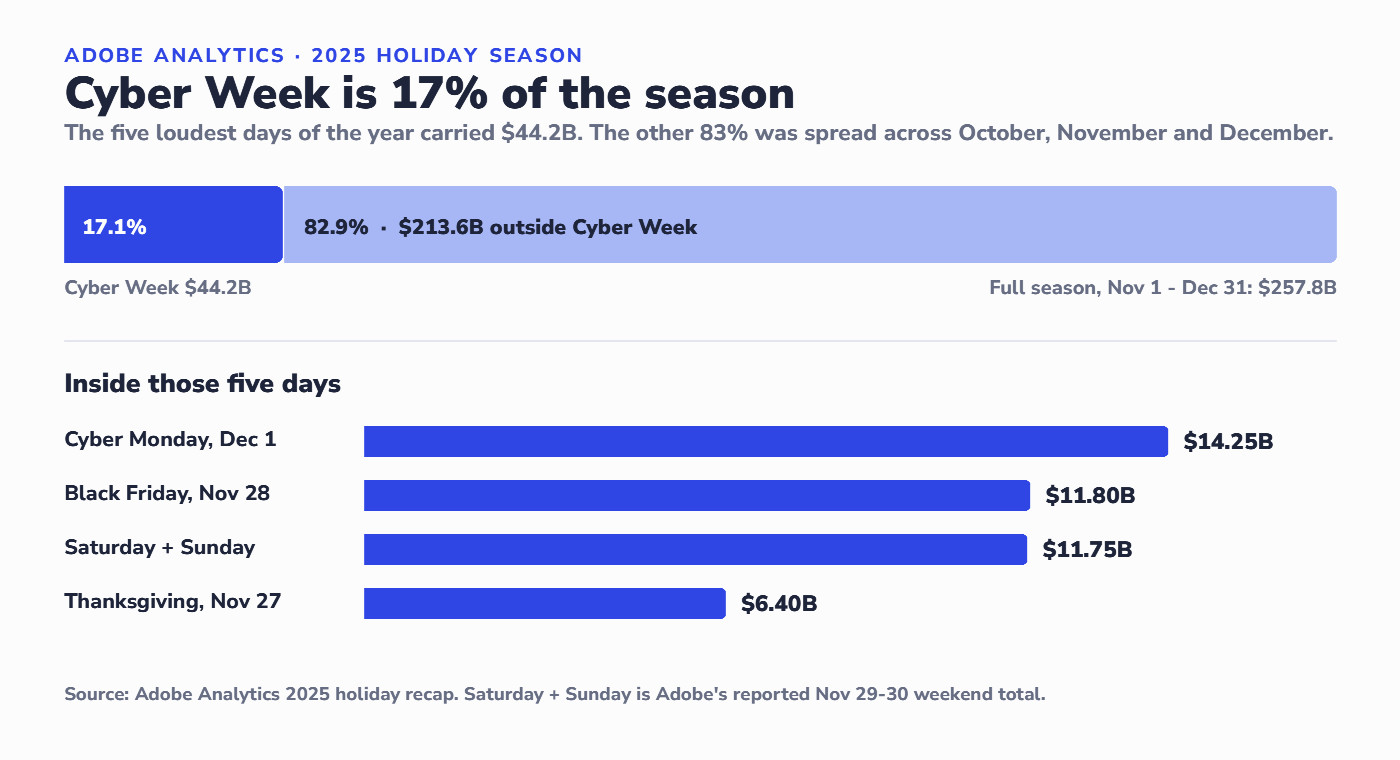
Adobe Analytics put US online holiday spending at $257.8 billion between November 1 and December 31, 2025, up 6.8% year over year. Cyber Week — the five days from Thanksgiving through Cyber Monday — accounted for $44.2 billion of that. That is roughly 17% of the season. Black Friday itself drove $11.8 billion and Cyber Monday $14.25 billion.
So five days carry about a sixth of the money, and the remaining 83% is spread across October, early November and the whole of December. An agency that only builds a Cyber Week campaign is building for the smallest, most expensive, most crowded slice of your season.
The timing data says the same thing from the shopper’s side. The National Retail Federation’s 2025 holiday survey of 8,247 US adults found 42% planned to begin browsing and buying before November, while 63% expected to do most of their shopping from Thanksgiving weekend onward. Those are two different audiences reachable in two different ways, and one campaign cannot serve both.
Forecasts for 2026 point further in that direction: the peak is expected to flatten into an October-to-December plateau rather than spike on one weekend. If that holds, the agencies that win 2026 are the ones already treating the season as a quarter rather than a weekend.
It is worth looking at the longer arc too, because the “Black Friday is dying” take comes back every autumn and the data has never supported it.
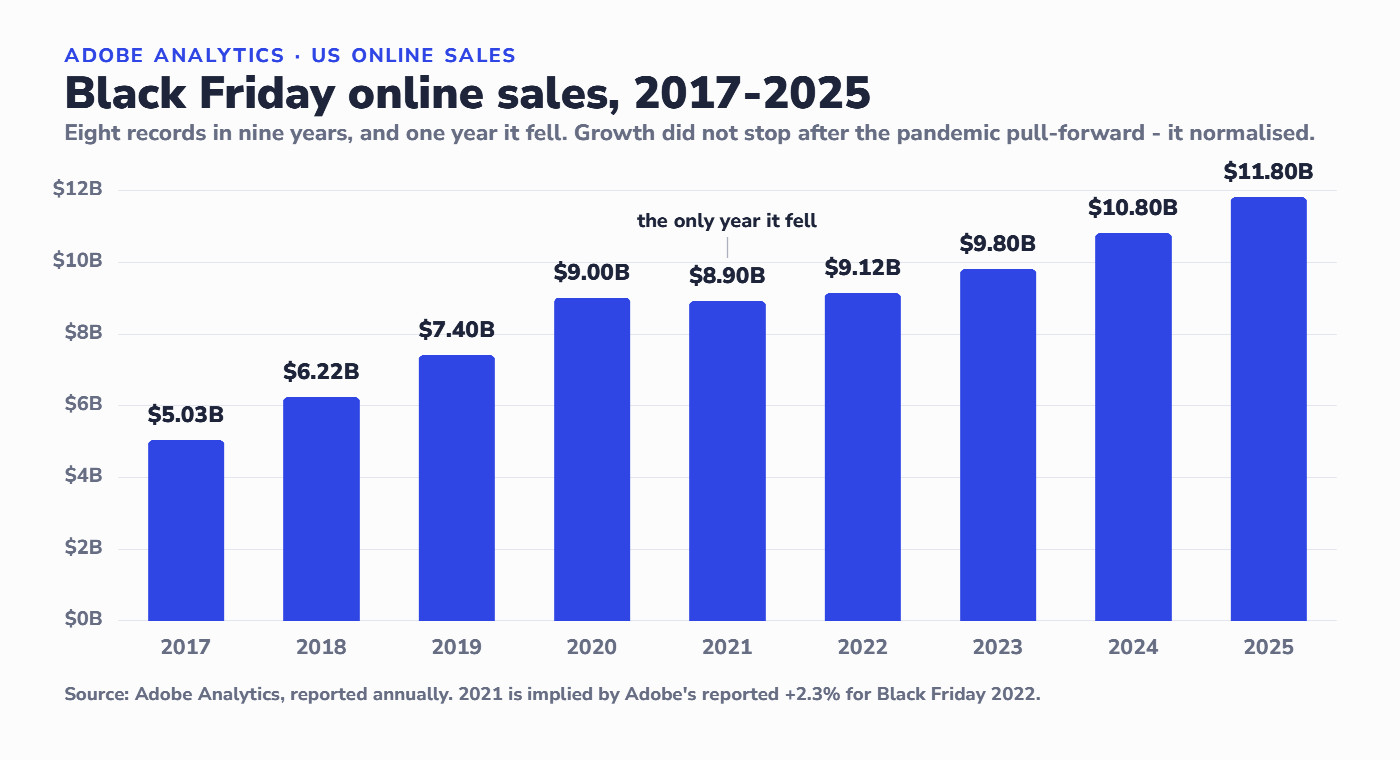
Two things stand out in nine years of Adobe’s numbers. The day has more than doubled, from $5.03 billion in 2017 to $11.8 billion in 2025. And it has fallen exactly once — in 2021, when the pandemic had already pulled a year of ecommerce growth forward into 2020 and retailers spread their promotions across the whole of November to dodge supply-chain chaos.
That 2021 dip is the useful part of the chart, because it is the shape the market has kept. Growth came back at 7.5%, then 10.2%, then 9.1% — healthy, but no longer concentrated in one afternoon. The season got longer while the headline day got bigger. A campaign plan built only around the headline day is fighting for a shrinking share of a growing pot.
What does a Klaviyo agency actually do for Black Friday?
The credible ones do four things, in this order:
- Grow and segment the list before the traffic arrives. Every buyer you sell to in November has to be on the list in October. That means signup capture, VIP and early-access segments, and suppressing profiles that will only damage your deliverability.
- Protect the inbox. This is the part brands underestimate. Klaviyo’s BFCM 2025 report — covering 22.7 billion messages and more than $3.8 billion in attributed revenue — found open rates fell to 18.3% during BFCM against a 21.5% annual average. The inbox is at its most crowded exactly when it matters most, and sending reputation cannot be bought back in November.
- Build the flows that carry the traffic. Cart and browse abandonment do the quiet work while campaigns take the credit.
- Convert the second purchase. Klaviyo found revenue from repeat customers grew 13.5% year over year over BFCM, outpacing new-buyer revenue. A one-time spike with no post-purchase follow-up is a rented result.
One more finding worth sitting with, because it contradicts what most brands assume: the brands offering the smallest discounts saw the highest growth over BFCM 2025, up 14%. Depth of discount was not the lever. Knowing which segment to send what was.
What does good BFCM email performance actually look like?
Most agencies will quote you a revenue multiple. Multiples are unfalsifiable. Engagement benchmarks are not, and Klaviyo publishes them across 22.7 billion BFCM messages, so you can hold any agency — including us — against the same numbers.
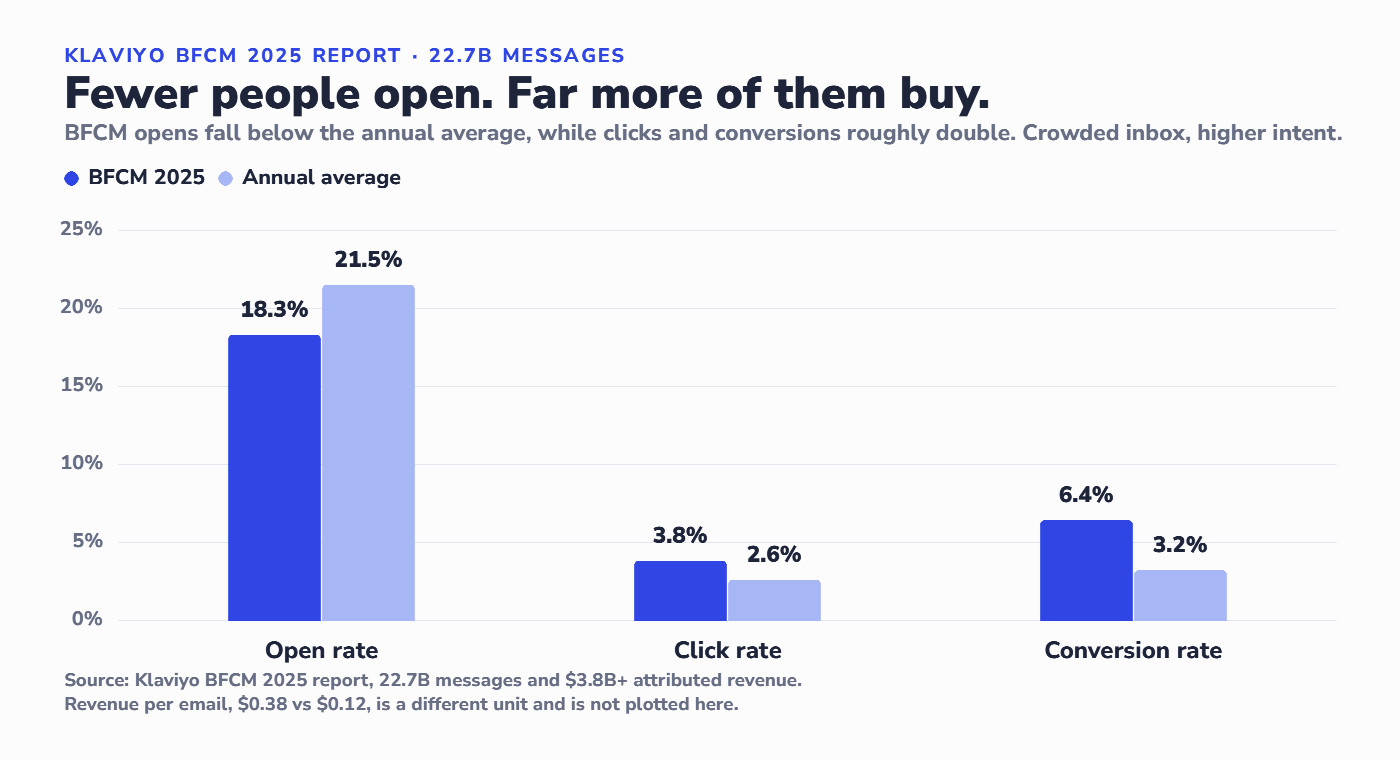
This is the chart we show brands who think their BFCM open rate looks broken. Opens do fall during BFCM — 18.3% against a 21.5% annual average — because every brand on the list is sending at once. What matters is what happens after the open: click rate rises from 2.6% to 3.8%, and conversion rate goes from 3.2% to 6.4%. Revenue per email triples, $0.38 against $0.12.
The practical read: in BFCM week, open rate is a vanity metric and a distraction. Judge the work on revenue per recipient and on conversion rate, and be suspicious of any agency that reports opens as its headline number in November.
Who are the main Klaviyo agencies in 2026?
Here is the landscape as these agencies position themselves, organised by who they fit rather than ranked one to ten. A ranking from any agency that includes itself is worth exactly what you would expect.
| Agency | Best fit | Focus | Notable |
|---|---|---|---|
| Flowium | Brands wanting one team on the whole retention program | Email + SMS retention only | Klaviyo Master Elite partner; publishes a 15-agency list of its own |
| Chronos Agency | DTC under roughly $30M | Ecommerce email + SMS | Klaviyo Master partner |
| Avex | $20M+ fashion, beauty, luxury | Shopify Plus design-led | Email matches the site; enterprise DTC |
| Propel | Data-led teams | Lifecycle + analytics | Retention decisions driven by modelling |
| Underground eCom | Eight-figure businesses | End-to-end email, SMS, retention | Capacity a seven-figure store will not use |
| Sweat Pants Agency | Brands buying paid and owned together | Email/SMS + Meta + Google | Worked with two Inc. 500 no.1 fastest-growing brands |
| Topology | Fashion and apparel | Boutique Klaviyo | Small team, narrow vertical |
| MarketerHire | Teams who want to manage the work themselves | Freelance marketplace, not an agency | Two-week trial on each placement |
| DIDO Agency | DTC doing $1M–$10M | Email + SMS retention | Gold Klaviyo Partner since 2017; 90-Day Growth Guarantee; no contracts |
The detail behind each one:
- Flowium — positions as an all-in-one retention partner covering strategy, campaign management and automations. A reasonable fit if you want one team owning the whole owned-channel program.
- Chronos Agency — a Klaviyo Master partner focused on ecommerce email and SMS for DTC brands under roughly $30M.
- Avex — design-forward Shopify Plus agency working with enterprise DTC in fashion, beauty and luxury. Built for $20M+ brands where the email has to match the site.
- Propel — lifecycle marketing with an analytics emphasis, aimed at brands that want retention decisions driven by data modelling.
- Topology — a boutique shop specialising in Klaviyo for fashion and apparel.
- Underground eCom — positions as end-to-end email, SMS and retention for fast-growth DTC. Infrastructure built for eight-figure businesses, so a seven-figure store will pay for capacity it cannot use.
- Sweat Pants Agency — runs paid and owned together, pairing email and SMS with Meta and Google ads, and leads on having worked with two Inc. 500 number-one fastest-growing brands. A fit if you want one team across acquisition and retention rather than a Klaviyo specialist.
- MarketerHire — not an agency but a marketplace that places freelance marketers, with a two-week trial on each hire. A fit if you want a contractor you brief and manage yourself, rather than a team that owns the result. Worth knowing the difference before you compare the two on price.
- DIDO Agency — that is us, so treat this as our own claim rather than a verdict. Gold Klaviyo Partner since 2017, built specifically for DTC brands doing $1M–$10M, with five specialists on each account. What we do differently is put the risk on our side: month-to-month with no contracts, you own every asset we build, and the 90-Day Growth Guarantee means that if your Klaviyo-attributed revenue in the first 90 days does not beat your previous 90, you stop paying until it does. We can offer that because our average client stays about three years without ever signing a contract.
What should a Klaviyo agency cost in 2026?
Nobody in this market likes publishing prices, so here is what the agencies themselves say. The 2026 guides put retainers at $3,000–$6,000 a month at the small end, $6,000–$12,000 for most mid-market DTC brands, and $12,000–$25,000 at enterprise, with one-time flow builds running $5,000–$25,000 (MarketerHire). Flowium’s own guide puts the general range slightly lower, at $2,500–$10,000 a month. Both are worth reading, and both are written by parties with an interest in the answer.
Two things to do with those numbers. First, convert the retainer into a break-even: at $8,000 a month, the work has to add roughly $32,000 in incremental email revenue at a 25% contribution margin before you are level. If an agency cannot tell you what it expects to add, you are buying activity. Second, ask what the fee covers in November specifically. Some retainers are priced on a normal sending calendar and quietly bill BFCM as a project.
Agency, freelancer, or in-house?
The honest comparison, because for a lot of brands reading this the answer is not an agency:
| Typical cost | Works when | Breaks when | |
|---|---|---|---|
| Agency | $3K–$25K/mo | You want strategy, deliverability and production owned by one accountable team through Q4 | You are under ~$1M and the retainer outruns the return |
| Fractional expert | $4K–$10K/mo | You have a marketer who can brief and review, and you need senior judgement not hands | Nobody internally has time to run the person |
| Full-time hire | $90K–$140K base | Email is a permanent channel and you can keep them busy all year | You need six specialisms and hire one generalist |
What are the red flags?
- A ranked list with themselves at the top. Now you know how those get made.
- ROI multiples with no baseline. “40X on email” means nothing without knowing what share of that revenue would have arrived anyway.
- No deliverability plan you can audit. Ask to see how they will warm and monitor your sending domain. Vagueness here is the single most expensive kind.
- A twelve-month contract for a seasonal problem. If the work is good, it does not need a lock-in.
- Open rate as the headline November metric. See the benchmark chart above.
- They will not name who touches the account. One generalist doing strategy, copy, design and deliverability is a bottleneck with a job title.
How do you know whether you need an agency at all?
Be honest about your revenue stage, because the answer changes:
- Under about $1M/year: a retainer will eat the return. A skilled freelancer, or Klaviyo’s own onboarding resources, is the better buy. Revisit agencies once your list is large enough that a single flow improvement is worth four figures a month.
- $1M–$10M: this is where an agency earns its fee, because your list is big enough that segmentation and deliverability work compound.
- $10M+: you need an agency with the infrastructure and headcount to match, and you will likely want dedicated design capacity.
What should you ask before you sign?
Five questions that separate the agencies that will do the work from the ones that will manage you:
- “Show me live campaigns you are running right now for a brand my size.” Not a portfolio deck. Actual sends. Generic discount-led copy with weak subject lines is a red flag no partner tier conceals.
- “What happens in the first 14 days?” A credible answer is specific: deliverability audit, list hygiene, the two flows that carry the most revenue.
- “Who actually touches my account?” One generalist account manager and a freelancer, or specialists in strategy, copy, design, automation and deliverability?
- “What happens if it does not work?” Listen for whether the downside sits with you or with them.
- “Who owns what you build if we leave?” Your flows, templates and segments should be yours. Some agencies treat them as leverage.
How late is too late to hire for Black Friday 2026?
The honest cutoff for a full build is around October 10. After that, list growth has not had time to compound and sending reputation has not had time to warm, which are the two things that cannot be rushed in November.
That does not make November pointless — it changes what is worth doing. A focused sprint on deliverability, abandonment flows, an early-access segment and one pre-season campaign will still move the number. It just will not be the same number as starting in September.
If you want to know where your own account stands before you talk to anyone, that is what our free BFCM audit and season roadmap is for: a 200+ point review of your program, a sweep of 3–5 competitors’ last season, and a dated roadmap through December 31. It comes back in 2–4 business days, there is no pitch unless you ask for one, and the roadmap is yours to keep — including if you take it to a different agency.
What we would actually do in your position
Put the hiring question down for ten minutes and do this first, because it costs nothing and it changes the brief you give whoever you hire.
- Pull two numbers out of Klaviyo: email and SMS revenue as a share of total for last November, and your engaged-list size today versus the same date last year. If the share is under 20% or the list is flat, the problem is upstream of campaign design and no amount of Black Friday creative fixes it.
- Check the four flows before touching campaigns. Welcome, browse abandonment, cart abandonment, post-purchase. On most accounts we audit, these carry the majority of automated revenue and have not been rewritten in two years. This is the cheapest work with the highest return, and it pays in December and January too.
- Look at your sending reputation in early October, not late November. If you have been sending to a cold list, the repair takes weeks and it cannot be compressed.
- Then decide who you need. If steps one to three turn up a healthy list, working flows and a decent reputation, you may only need a freelancer for campaign production. If they turn up a flat list and neglected flows, that is a real programme and it needs a team.
And a note on timing that is against our own commercial interest: if it is already November when you read this, do not sign a new retainer for Black Friday. You will pay onboarding cost for a build that cannot land in time. Run the season with what you have, and hire in January when the work can compound through the whole year instead of one weekend.
Frequently asked questions
When is Black Friday 2026?
Friday, November 27, 2026. Thanksgiving falls on November 26 and Cyber Monday on November 30.
How much does a Klaviyo agency cost?
Most retainers for the $1M–$10M band run in the low thousands per month depending on send volume and whether SMS is included. Our own plans are published on our monthly plans page rather than hidden behind a call.
Should I switch agencies right before Black Friday?
Usually not mid-season. But getting an outside audit of your current setup costs nothing and tells you whether your existing agency has the season covered. If they do, you will know in writing.
Do I need to move to Klaviyo to work with a Klaviyo agency?
Not with us. We work in whatever stack you already have. A platform migration is not a project to run into a peak season.
Sources
- Adobe Analytics — 2025 holiday season, $257.8B online and Cyber Week and Cyber Monday records.
- Adobe Analytics, historical Black Friday figures as reported by CNBC (2023), CNBC (2020) and TechCrunch (2022).
- National Retail Federation — 2025 Winter Holiday Survey, 8,247 US adults, fielded October 1–7 2025.
- Klaviyo — BFCM 2025 report, 22.7 billion messages and $3.8B+ attributed revenue.
- Agency pricing ranges — MarketerHire and Flowium, 2026 guides.
Keep reading
- Black Friday & Cyber Monday: the triggers and strategies that work best — the flow and trigger detail this post only summarises.
- Strategies to master your email list before Black Friday — start here if step one above turned up a flat list.
- Segment your way to Black Friday success — how to cut the list so the sends stay relevant.
- The four focus areas of Black Friday email content — subject lines through to segmentation.
- Winning BFCM 2026: the full strategy and campaign calendar — the week-by-week plan, plus real client campaign results from a DIDO BFCM send.
- How Klaviyo’s AI actually works — what the platform automates and what it does not.