
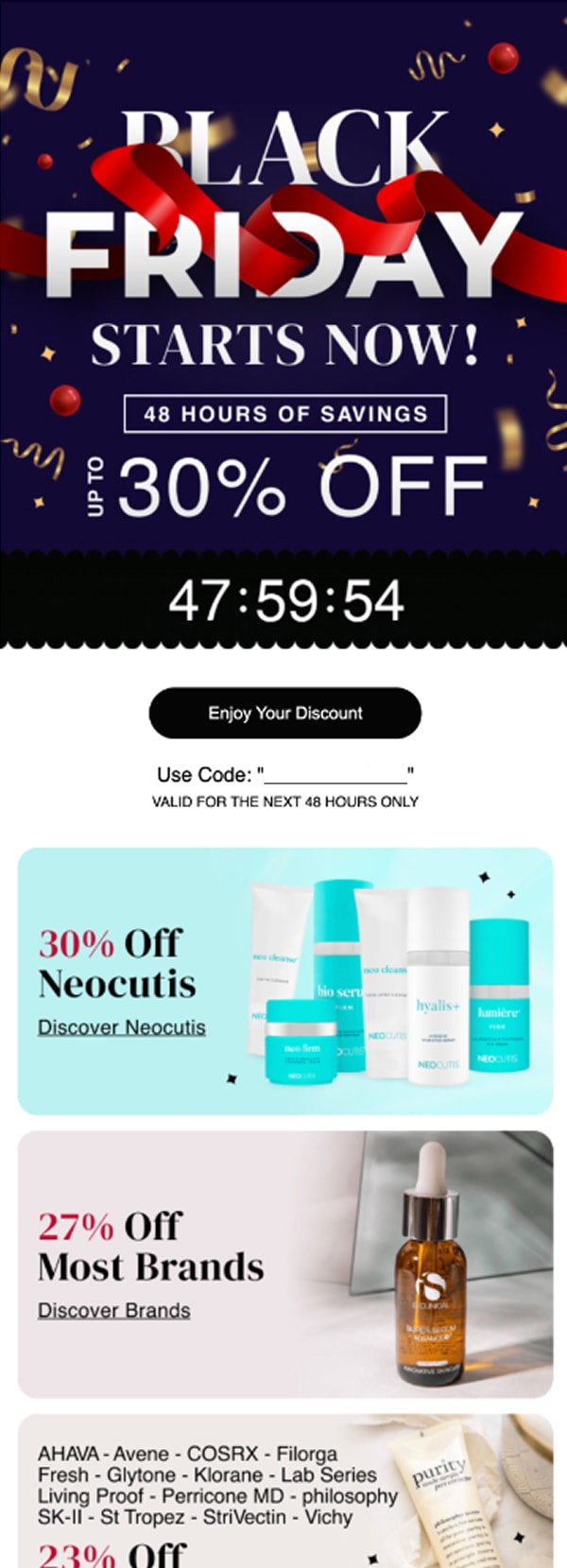
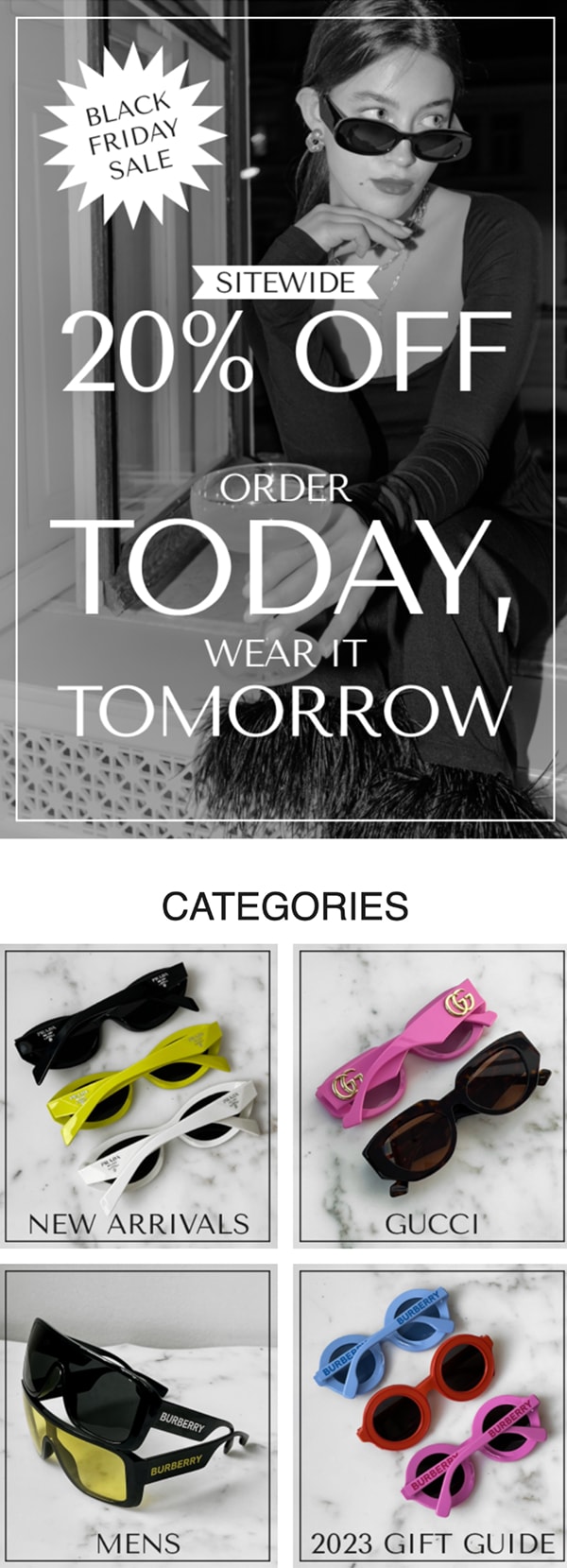
Now that you know which urgency and scarcity triggers to include in your Black Friday and Cyber Monday campaigns, here’s a quick checklist to help you implement this blog’s strategies, tips, and tricks.
✔ Start with your VIP and core subscriber segments
✔ Plan distinct urgency and scarcity strategies for every segment
✔ Set up automated triggers now to avoid losing customers on the hottest days of the year
✔ Use interactive elements like countdown timers, carousels, polls, and personalized product grids
✔ Optimize your urgency and scarcity strategies for both email and SMS, considering timing, frequency, and personalization.
And, if you need support maximizing the impact of your Black Friday and Cyber Monday campaigns this year, book a free call to see how DIDO Agency can help.
What has to be finished, and by when
Every trigger above is a build task, not a send-day decision. A countdown timer needs a working template and a tested merge tag. A low-stock alert needs inventory data flowing into your ESP. VIP early access needs a segment that has been validated against real purchase history, not a guess. None of that is work you do on the Wednesday before Thanksgiving.
Here is the calendar we plan client accounts against for 2026.
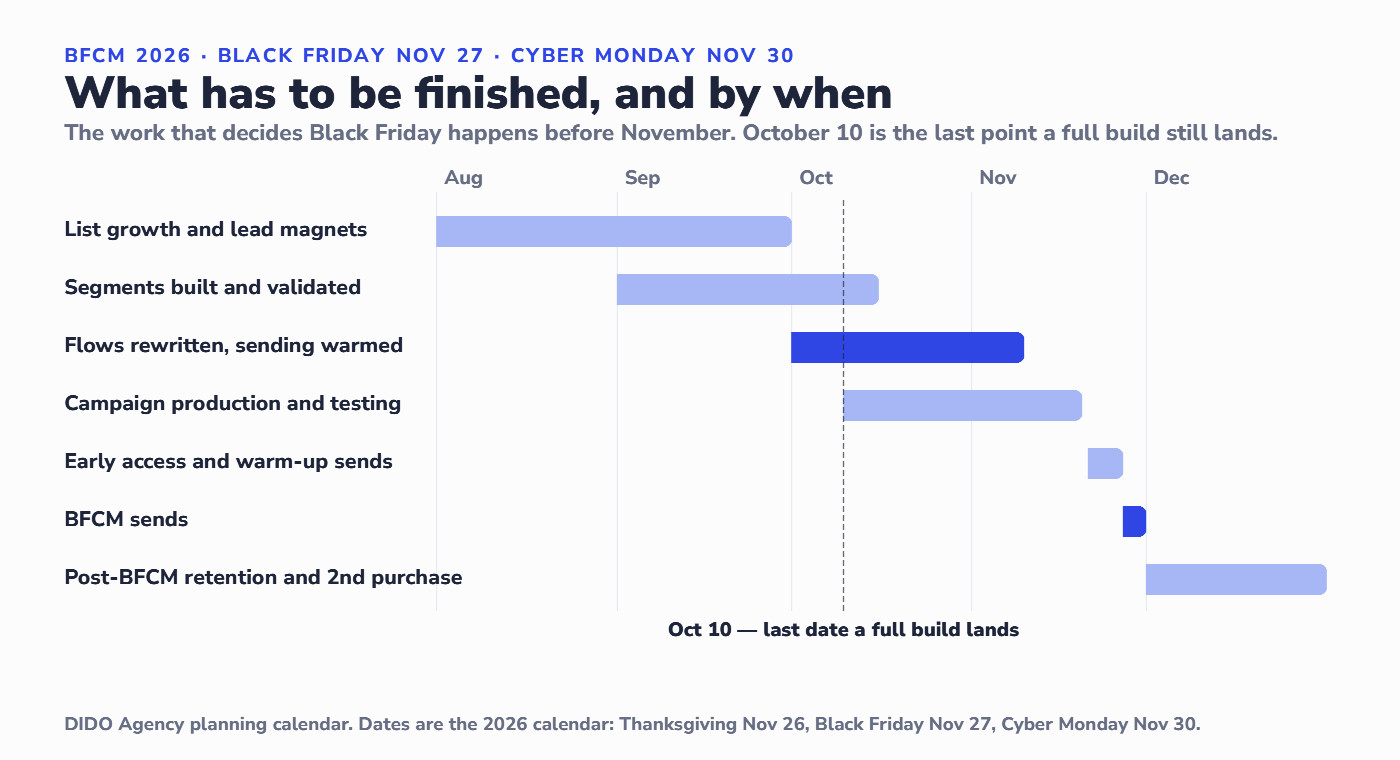
Two rows on that chart carry most of the risk. Flows rewritten and sending warmed is the one brands skip, because it produces nothing you can screenshot. It is also the one that cannot be compressed: if you have been sending to a list that has gone cold, repairing your sending reputation is a multi-week process of sending to your most engaged people first and widening slowly. Start that in November and you will be pushing your best offer of the year through a domain the mailbox providers have already decided to filter.
The second is early access and warm-up sends. The week before Black Friday is not dead air. It is where you tell your VIPs something is coming, re-engage the people who bought last November, and — critically — find out whether your templates render before the day the revenue depends on them.
October 10 is not an arbitrary line. It is the last point at which a full build (segments, flows, templates, deliverability, campaign calendar) can be finished, tested and warmed before the early-access window opens. After that the honest answer changes from “let’s build the season” to “let’s make the most of what you already have”.
What the data says about urgency during BFCM
Urgency is not a style choice during Black Friday week — it is a response to a measurable change in how people behave in a crowded inbox. Klaviyo published benchmarks across 22.7 billion BFCM messages and more than $3.8 billion in attributed revenue, and the shape of them is the argument for everything in this post.
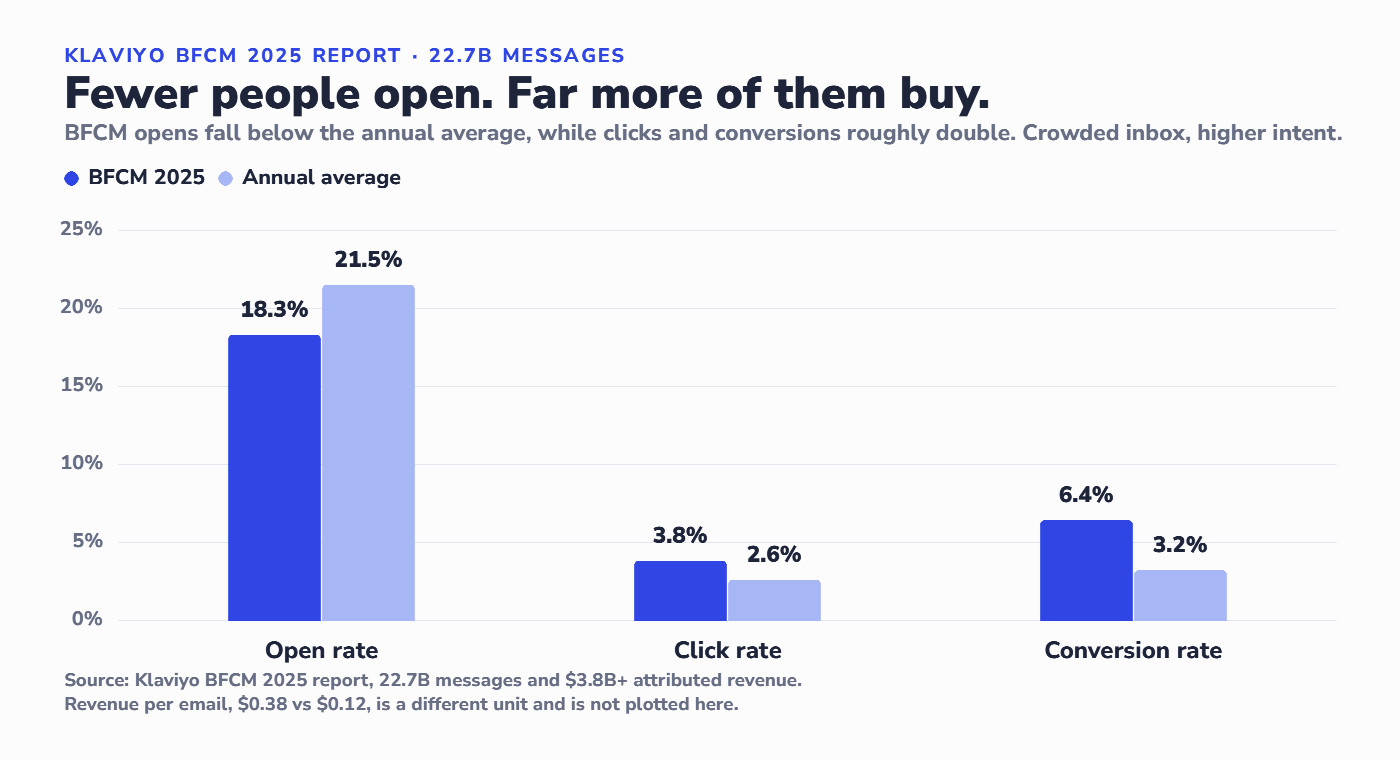
Read the three pairs in order. Open rate falls, from a 21.5% annual average to 18.3% during BFCM, because every brand on every list is sending at once and you are competing for attention against fifty other subject lines. Click rate rises, from 2.6% to 3.8%. And conversion rate doubles, from 3.2% to 6.4%. Revenue per email goes from $0.12 to $0.38.
So a smaller share of your list opens, and a much larger share of the people who do open go on to buy. That is what a high-intent window looks like in data, and it has two practical consequences.
First, open rate is the wrong number to judge November on. If your agency or your internal report leads with a dropped open rate as a problem in BFCM week, they are measuring the crowd, not your campaign. Judge the work on revenue per recipient and conversion rate.
Second, urgency earns its place because it moves people who are already close to buying. A countdown does not manufacture intent in someone who does not want your product. It removes the reason to defer a decision from someone who does. That is why these triggers work in this window and read as pushy in March.
One more finding from the same report is worth sitting with, because it contradicts what most brands assume going into a discount weekend: the brands running the smallest discounts grew fastest, at +14%. Revenue from repeat customers grew 13.5% year over year. Depth of discount was not what separated the winners.
Four more triggers worth building
The four above are the ones nearly every brand runs. These are the ones that tend to be left on the table, and each is a build task you can finish before October 10.
5. Free-shipping threshold nudge
Why it works
✔ It raises average order value without discounting the product
✔ It gives the customer a reason to add rather than a reason to hesitate
Example
“You’re $12 away from free shipping — and the offer ends Monday.”
Build note
→ This needs the cart value passed into the message, so it is a flow, not a campaign. Test the dynamic block in October; a threshold nudge that renders as “You’re $0.00 away” is worse than no nudge at all.
6. Back-in-stock and price-drop alerts
Why it works
✔ The scarcity is real and the customer opted into it, which is the highest-intent trigger in the whole set
✔ It fires on the customer’s timing rather than your send calendar, so it lands outside the peak-noise hours
Example
“The one you wanted is back — and it’s 30% off until Monday.”
Build note
→ Put the back-in-stock form on every out-of-stock product page in October. The list you collect in the six weeks before Black Friday is the most purchase-ready segment you will own.
7. Tiered discount or bundle ladder
Why it works
✔ It sets the anchor at the basket you want rather than the cheapest thing you sell
✔ It lets you run a shallower headline discount, which is what the fastest-growing brands did in 2025
Example
“20% off two, 30% off three. Ends Monday at midnight.”
Build note
→ Decide the ladder before you write the creative. Rewriting a tiered offer after the templates are built is where most November fire-drills come from.
8. Loyalty-points multiplier
Why it works
✔ It creates urgency without touching price, which protects margin on your best-selling lines
✔ It rewards the customers who already buy from you, and points redeemed in January bring them back in the quietest month of the year
Example
“Triple points this weekend only — on everything.”
Build note
→ Only worth it if your loyalty programme is already live and people understand what a point is worth. A multiplier on a programme nobody uses is a discount you did not get credit for.
Which trigger for which segment
The most common mistake we see is not choosing the wrong trigger — it is sending the same trigger to the whole list. A lapsed customer and a VIP need opposite things from the same weekend. Here is how we map them.
| Segment | Lead with | Avoid | Timing |
|---|---|---|---|
| VIPs and repeat buyers | VIP early access, loyalty multiplier | Deep sitewide discounts — you are discounting revenue you would have had | Before the public sale opens |
| Engaged non-buyers | Countdown timers, tiered offer | Low-stock alerts on items they never viewed | Peak days, multiple touches |
| Browsed, did not buy | Back-in-stock, price drop, browse abandonment | Generic sitewide messaging | Triggered, not scheduled |
| Cart abandoners | Cart reminder flow, free-shipping threshold | Adding a second discount on top — it trains the behaviour | 1 hour, 6 hours, 24 hours |
| At risk (60–120 days quiet) | Strongest single incentive, one clear CTA | Multi-offer emails; they will not read them | Early access window, then once on peak day |
| Lapsed (180+ days) | Win-back with the best offer of the year | High send frequency — it costs you deliverability | One or two sends, tightly capped |
The last row matters more than it looks. Blasting a 180-day-lapsed segment during the highest-volume week of the year is how brands damage their sending reputation on the exact days it is worth the most. Cap it, send to the most recently active slice of it first, and stop if the engagement is not there.
When urgency backfires
Urgency stops working the moment a customer suspects it is fake, and it takes the rest of your email programme down with it. Three failure modes are worth naming, because we see all three every season.
The timer that resets. A countdown that starts again on every page load or every email open is not urgency, it is a tell. Shoppers screenshot timers and compare them; the ones who notice do not complain, they stop opening. If a deadline is real, the timer should reach zero and the offer should actually end.
Stock counts that never move. “Only 3 left” sitting at three for a fortnight is the same problem. If your inventory data does not flow into your ESP, use scarcity language you can stand behind — a genuinely limited bundle, a real cut-off time — rather than a number you cannot substantiate.
Every email being the final chance. Four consecutive “last chance” sends teach your list that your deadlines are decorative. Urgency is a finite resource across a season: spend it on two or three genuine moments and let the rest of the calendar carry information instead.
There is a compliance dimension too. Advertising rules in the US, UK and EU all treat false claims of limited availability or limited time as deceptive, and the enforcement risk sits with the brand rather than the platform. We are not lawyers and this is not legal advice, but the practical rule is simple and it is also the commercially correct one: if you would not be comfortable showing a customer the data behind the claim, do not make the claim.
What we would do in your position
If you take nothing else from this, take the order of operations. Most brands do these in reverse and wonder why the weekend underperformed.
- Check the four flows before you plan a single campaign. Welcome, browse abandonment, cart abandonment, post-purchase. On most accounts we audit these carry the majority of automated revenue and have not been rewritten in two years. Fixing them pays in December and January as well as on Black Friday, which no campaign does.
- Look at your sending reputation in the first week of October. Not November. If it needs repair, that repair is the project and the campaign calendar has to fit around it.
- Build and validate the segments in September. A segment you build on November 25 has not been tested against anything.
- Pick two urgency moments, not six. One at the open, one at the close. Fill the middle with information — gift guides, comparisons, shipping deadlines — so the deadlines you do use still mean something.
- Decide your reporting metric now. Revenue per recipient and conversion rate, not opens. Write it down before the season so nobody relitigates it in December.
And the honest timing advice, against our own commercial interest: if you are reading this in November, do not onboard a new agency for Black Friday. You will pay setup cost for a build that cannot land. Run the season with what you have, then fix the foundations in January when the work compounds across the whole year instead of one weekend.
A worked send calendar for BFCM 2026
Triggers are easier to judge in a calendar than in a list, because the question is never “is a countdown good?” but “what is this send for, and who is it going to?” This is the shape we build against. Adjust the discount depth to your margins; the structure is what transfers.
| Date | Send | Segment | Trigger used |
|---|---|---|---|
| Nov 16–20 | “Something is coming” teaser | Engaged 90 days | Anticipation only — no discount, no timer |
| Nov 21 | VIP early access opens | VIPs, repeat buyers | VIP early access + loyalty multiplier |
| Nov 23 | Gift guide / shipping deadlines | Full engaged list | Information, not urgency |
| Nov 26 | Thanksgiving soft open | Engaged 60 days | Countdown to the public sale |
| Nov 27 am | Black Friday launch | Full list, engaged first | Countdown timer + tiered offer |
| Nov 27 pm | Best-sellers / low stock | Openers who did not click | Limited stock alerts |
| Nov 28–29 | Weekend continuation | Non-purchasers, browsers | Back-in-stock, browse abandonment |
| Nov 30 am | Cyber Monday launch | Full list | New offer, fresh countdown |
| Nov 30 pm | Final hours | Engaged + cart abandoners | Genuine deadline — the offer must end |
| Dec 1–5 | Second-purchase flow | Everyone who bought | Post-purchase, cross-sell, no discount |
Two things about that calendar are deliberate. Only three sends use a countdown, and the final one is the only send where a deadline is presented as final — because it is. And the last row is the one brands cut first and should cut last: Adobe put the full 2025 season at $257.8 billion against Cyber Week’s $44.2 billion, so the majority of the money is still on the table after Cyber Monday closes. A second-purchase flow in the first week of December is the cheapest revenue in the entire quarter.
Urgency on SMS is a different instrument
SMS is where most of the timing mistakes happen, because the channel punishes the things email tolerates. Three rules we hold to.
Send fewer, later. SMS earns its place at the two moments a deadline is genuinely closing — a few hours before the Black Friday offer changes, and a few hours before Cyber Monday ends. A brand sending six texts across the weekend is not being urgent, it is training people to unsubscribe on the most expensive list they own.
Respect quiet hours, and know they are not optional. Consent and timing rules for marketing texts are enforced against the brand, not the platform, and the penalties are per message. Your ESP will have quiet-hour settings; use them, and do not override them because the deadline is at midnight. Set the final send for the evening before instead.
Write for a screen with no subject line. The offer, the deadline and the link belong in the first line. There is no preview text to carry context and no second chance at the scroll. If the message needs two sentences of set-up, it should have been an email.
The intent pattern is the same one the email data shows. Klaviyo measured revenue per email tripling during BFCM, from $0.12 to $0.38, because the people engaging in that window are close to buying. A well-timed text reaches the same person at the same moment on a device already in their hand — which is exactly why it works twice a weekend and stops working at six.
How to tell whether the triggers worked
Every trigger in this post has a metric that tells you the truth about it, and a metric that will flatter it. Decide which you are reporting before the season starts.
| Trigger | Judge it on | Ignore |
|---|---|---|
| Countdown timer | Click-to-conversion rate on the send, and revenue in the final six hours | Open rate — it moves with the crowd, not your creative |
| Limited stock alert | Sell-through on the flagged SKUs | Total campaign revenue, which hides which items moved |
| VIP early access | Revenue per recipient vs the public send, and VIP repeat rate in December | Absolute revenue — the segment is small by design |
| Cart abandonment flow | Recovered revenue per abandoned cart | Flow open rate |
| Free-shipping threshold | Average order value against a holdout | Click rate |
| Back-in-stock | Conversion rate — it should be the highest of any send you make | List size; a small high-intent list beats a large cold one |
| Tiered discount | Units per order and blended margin | Headline discount percentage |
| Loyalty multiplier | Points redeemed in January and repeat purchase rate | Immediate weekend revenue |
The pattern across that table: the honest metric is almost always downstream of the click, and it usually shows up after the weekend. That is uncomfortable for a Monday-morning report and it is the reason so many BFCM post-mortems conclude nothing useful. Agree the measurement window in October — ours is the season, November 1 to December 31, not the five days — and the numbers will actually tell you what to repeat next year.
What is different about the 2026 season
The tactics above are stable year to year. The context they run in is not, and three shifts change how you should weight them for 2026. These are forecasts rather than actuals, and worth treating as such.
The peak is flattening into a plateau. Forecasts point to the season spreading further across October to December rather than concentrating on the five days, with Cyber Week holding at roughly 17.2% of a season projected near $253 billion — about $43.7 billion. That is the same share as 2025 on a slightly larger base. For your send calendar it means the October and December wings deserve real campaigns, not leftovers, and it strengthens the case for the second-purchase flow in the first week of December.
Intent to shop the two headline days remains high. Roughly 73% of shoppers say they plan to shop Black Friday and 61% Cyber Monday. That is the argument for keeping two distinct offers rather than one continuous sale: a meaningful share of your list is waiting specifically for Monday, and giving them the identical Friday message wastes the only genuinely fresh deadline you have left.
Buy-now-pay-later keeps growing, with forecasts putting it past $22 billion for the season. If BNPL is available at your checkout and you are not saying so in the messages carrying your highest-price bundles, you are letting a real objection go unanswered at the exact moment someone is deciding. It belongs in the tiered-offer and free-shipping-threshold sends, where basket size is the thing you are trying to move.
None of this changes the order of operations. Flows before campaigns, reputation before volume, segments before creative. It changes the weighting: a 2026 plan that ends on November 30 is planning for about a sixth of the money.
Frequently asked questions
When is Black Friday 2026?
Friday, November 27, 2026. Thanksgiving is November 26 and Cyber Monday is November 30.
Do countdown timers actually work in email?
They work when the deadline is real. The mechanism is removing a reason to defer, not creating desire — which is why they perform in a high-intent window like BFCM, where Klaviyo measured conversion rates doubling to 6.4%, and read as pushy outside it. A timer that resets does measurable long-term damage.
How many emails should I send during BFCM?
There is no single right number, but the constraint is deliverability rather than tolerance. Send more to your engaged segments and less to your quiet ones, rather than raising frequency evenly across the list. Send volumes across retail rose roughly 20–24% year over year in BFCM 2025, so the inbox you are sending into is more crowded each season.
Should I discount more deeply than last year?
The 2025 data argues against it. Klaviyo found the brands with the smallest discounts grew fastest, at +14%. Depth of discount was not what separated the winners; segmentation and timing were.
Is it too late to start if it is already October?
Early October, no. After roughly October 10 a full build stops being realistic, and the honest plan becomes a focused sprint on the flows and the two or three segments that carry the most revenue.
Should I run one sitewide sale or category-level offers?
Category offers give you more distinct sends without repeating yourself, which matters when you need seven or eight messages across a weekend. They also let you protect margin on the lines you do not want discounted. The trade-off is complexity: every extra offer is another template, another segment and another thing to test before October 10.
Email or SMS for the final deadline?
Both, at different times. Send the final email in the afternoon and the SMS a few hours before the offer changes, inside permitted sending hours. Do not set the last text for midnight just because that is when the sale ends — move the send earlier and say the deadline in the message instead.
What should I measure during BFCM?
Revenue per recipient and conversion rate. Open rate drops during BFCM for everyone — 18.3% against a 21.5% annual average — so treating it as a performance signal in November will lead you to the wrong conclusions.
Black Friday 2026: the dates that matter
Black Friday 2026 falls on Friday, November 27, with Cyber Monday on Monday, November 30. Thanksgiving is November 26. If a full email and SMS build has to be finished, tested and warmed in time, the honest cutoff is around October 10 — after that, list growth and sending-reputation work cannot compress into the calendar that is left.
Two figures worth planning against, both published. Adobe Analytics put the 2025 US online holiday season (November 1 to December 31) at $257.8 billion, of which Cyber Week carried $44.2 billion — about 17% of the season, leaving the other 83% spread across October, November and December. And the NRF’s 2025 Winter Holiday Survey found 42% of shoppers begin browsing and buying before November. Both point the same way: the campaign that only fires on the weekend is competing for the smallest slice of the season.
Keep reading
- Best Klaviyo agencies for Black Friday 2026 — the market data, a nine-agency comparison and what a retainer actually costs in 2026.
- Winning BFCM: the full strategy and campaign calendar
- Four focus areas for Black Friday email content
- Segment your way to Black Friday success
- Grow your email list before Black Friday
Sources
- Klaviyo — BFCM 2025 report: 22.7 billion messages, $3.8B+ attributed revenue. Open 18.3% vs 21.5% annual, click 3.8% vs 2.6%, conversion 6.4% vs 3.2%, revenue per email $0.38 vs $0.12, repeat-customer revenue +13.5% YoY, smallest-discount brands +14%.
- Adobe Analytics — 2025 Cyber Week and Cyber Monday records: Cyber Week $44.2B, Black Friday $11.8B, Cyber Monday $14.25B, season $257.8B.
- National Retail Federation — 2025 Winter Holiday Survey, 8,247 US adults, fielded October 1–7 2025: 42% begin browsing and buying before November.